There are 10 situations where consumers should keep their debit card in their wallet, according to CreditCards.com. periodicals, provides some of the advice.
Don't use a debit card online. Not using debit cards online was No. 1 on the list. Since the debit card links directly to a checking account, .
Most lists warn against letting a credit or debit card out of sight at a restaurant, but restaurants are one of the few places where the consumer must let the card out of sight to use it. Avoiding such situations isn't workable.
Some gas stations and hotels will place holds to cover customers who may leave without settling the entire bill.
That means that even though the consumer bought only $10 in gas, the hotel can have a temporary banking hold for $50 to $100/ The practice isn't as noticeable if paying with a credit card but can be problematic for debit card users with just enough funds in the account to cover the purchase.
Don't use debit cards for:
1. Online;
2. For big-ticket items;
3. When a deposit is required;
4. At restaurants;
5. If you're a new customer;
6. When you buy now and take delivery later;
7. For recurring payments;
8. For future travel;
9. At gas stations and hotels; and
10.When the ATM looks "off."
Thursday, March 18, 2010
CUNA advises on 10 places not to use a debit card
Wednesday, March 17, 2010
Data Breach Incidents Cost U.S. Companies
The Ponemon Institute released a study last month which examined 43 organizations across 17 different industry sectors, showing that data breach incidents cost U.S. companies $202 per compromised customer record in 2008, compared to $197 in 2007.
Since the study's inception in 2005, this cost component has grown by more than $64 on a per victim basis, nearly a 40% increase.
Tuesday, March 16, 2010
Convictions for Major Hackers
Albert Gonzalez, the convicted ringleader of a major hacking and thieving operation that cost credit unions millions of dollars, awaits sentencing by a federal court. But as he awaits his fate, the cases of his co-conspirators are being resolved, according to court documents.
The latest is Humza Zaman, 33, former network programmer for Barclay's Bank. Zaman pled guilty to being part of the back-end, money laundering part of the Gonzalez operation rather than the hacking part.
Prosecutors charged Zaman with helping Gonzalex repatriate American currency that purchasers of the stolen card data paid for the information.
“In late 2005 and early 2006, Zaman traveled to California at Gonzalez’s direction on approximately three occasions,” the prosecutors said in a memo, which supported their recommendation that Zaman serve 46 months in federal prison with other penalties.
“There, he met with an unknown man of apparent Eastern European descent. On each occasion, Zaman picked up between $50,000 and $370,000 in currency. Zaman then put the currency, minus his cut, in Federal Express boxes and shipped the money using a fictitious name to Gonzalez in Miami,” the prosecutors added.
In the end the court agreed with the prosecutors, sentencing Zaman to 46 months in prison and a fine of $75,000.
The latest is Humza Zaman, 33, former network programmer for Barclay's Bank. Zaman pled guilty to being part of the back-end, money laundering part of the Gonzalez operation rather than the hacking part.
Prosecutors charged Zaman with helping Gonzalex repatriate American currency that purchasers of the stolen card data paid for the information.
“In late 2005 and early 2006, Zaman traveled to California at Gonzalez’s direction on approximately three occasions,” the prosecutors said in a memo, which supported their recommendation that Zaman serve 46 months in federal prison with other penalties.
“There, he met with an unknown man of apparent Eastern European descent. On each occasion, Zaman picked up between $50,000 and $370,000 in currency. Zaman then put the currency, minus his cut, in Federal Express boxes and shipped the money using a fictitious name to Gonzalez in Miami,” the prosecutors added.
In the end the court agreed with the prosecutors, sentencing Zaman to 46 months in prison and a fine of $75,000.
Online crime losses more than doubled in 2009
Online crime losses more than doubled during 2009, reaching $559.7 million, according to the Internet Crime Complaint Center (IC3). That compares with $265 million lost during 2008.
IC3 is a partnership between the Federal Bureau of Investigation (FBI) and the National White Collar Crime Center (NW3C).
The number of complaints also rose--to 336,655 complaints, or 22.3% more than the 275,284 complaints filed in 2008.
Complaints involved fraud and nonfraud categories including auction fraud, nondelivery of merchandise fraud, credit card fraud, computer intrusions, spam/unsolicited e-mail, and child pornography, said IC3.
In 2009, IC3 implemented a new complaint classification system, separating complaints into 79 categories. This resulted in a number of changes to the way the system gathers the data and classifies complaint data.
Among the significant findings for 2009:
> E-mail scams that used the FBI's name to gain information represented 16.6% of all complaints submitted. Nondelivered merchandise and/or payment accounted for 11.9% of complaints, advance fee fraud made up 9.8%. Rounding out the top five categories were identity theft and overpayment fraud.
> Of the top five categories of offenses reported, nondelivered merchandise and/or payment ranked 19.9%, identity theft, 14.1%, credit card fraud, 10.4%, auction fraud, 10.3%, and computer fraud (destruction/damage/vandalism), 7.9%.
> Of the complaints involving financial harm and referred to law enforcement, the highest median dollar losses were found among investment fraud ($3,200), overpayment fraud ($2,500), and advance fee fraud ($1,500).
>Among complainants, 54% were male, nearly two-thirds were between the ages of 30 and 50, and more than one-third resided in either California, Florida, Texas or New York. Ninety-two percent of the complaints were from the U.S.
>Males lost more money than females. Men lost $1.51 to every $1 that women lost. Individuals who were between 40 and 49 years old on average lost more than other age groups.
IC3 is a partnership between the Federal Bureau of Investigation (FBI) and the National White Collar Crime Center (NW3C).
The number of complaints also rose--to 336,655 complaints, or 22.3% more than the 275,284 complaints filed in 2008.
Complaints involved fraud and nonfraud categories including auction fraud, nondelivery of merchandise fraud, credit card fraud, computer intrusions, spam/unsolicited e-mail, and child pornography, said IC3.
In 2009, IC3 implemented a new complaint classification system, separating complaints into 79 categories. This resulted in a number of changes to the way the system gathers the data and classifies complaint data.
Among the significant findings for 2009:
> E-mail scams that used the FBI's name to gain information represented 16.6% of all complaints submitted. Nondelivered merchandise and/or payment accounted for 11.9% of complaints, advance fee fraud made up 9.8%. Rounding out the top five categories were identity theft and overpayment fraud.
> Of the top five categories of offenses reported, nondelivered merchandise and/or payment ranked 19.9%, identity theft, 14.1%, credit card fraud, 10.4%, auction fraud, 10.3%, and computer fraud (destruction/damage/vandalism), 7.9%.
> Of the complaints involving financial harm and referred to law enforcement, the highest median dollar losses were found among investment fraud ($3,200), overpayment fraud ($2,500), and advance fee fraud ($1,500).
>Among complainants, 54% were male, nearly two-thirds were between the ages of 30 and 50, and more than one-third resided in either California, Florida, Texas or New York. Ninety-two percent of the complaints were from the U.S.
>Males lost more money than females. Men lost $1.51 to every $1 that women lost. Individuals who were between 40 and 49 years old on average lost more than other age groups.
Monday, March 15, 2010
Adjusting currency for blind would impact ATMs, CUs
Credit unions could be impacted by proposed changes to U.S. currency that would make denominations easier to read for the visually impaired.
The U.S. Bureau of Engraving and Printing is working to redesign banknotes after the U.S. Court of Appeals in the District of Columbia in 2008 upheld a 2006 lower court ruling that the federal government violated the U.S. Rehabilitation Act by not providing meaningful access to banknotes for the blind and visually impaired.
The Treasury is proceeding to redesign currency and will soon seek comment on the proposed designs. The comment period is expected to last about 90 days, said James Hanisch, executive vice president of CO-OP Financial Services in Rancho Cucamonga, Calif., a credit union service organization.
Depending on which design the Treasury proposes and what denominations will be affected, the changes could be a "fairly expensive proposition" for credit unions. The $20 bill is the most commonly dispensed at ATMs, and its change would have the largest impact. The $1 bill will be exempt, and the $100 bill will be grandfathered in the next redesign, Hanisch said.
Changes in currency sizes could mean adjustments to cash drawers, vaults, and ATM canisters and dispensers. ATM manufacturers already have the capabilities to change the machines, since many countries have already adjusted their currency sizes for the visually impaired, he added.
Currency changes could cost $3,000 to $5,000 per ATM, depending on the denomination. CO-OP offers about 28,000 ATMs, Hanisch said.
At minimum, the changes are a year a way. "It's just starting to sink in how significant this could possibly be," Hanisch said.
The U.S. Bureau of Engraving and Printing is working to redesign banknotes after the U.S. Court of Appeals in the District of Columbia in 2008 upheld a 2006 lower court ruling that the federal government violated the U.S. Rehabilitation Act by not providing meaningful access to banknotes for the blind and visually impaired.The Treasury is proceeding to redesign currency and will soon seek comment on the proposed designs. The comment period is expected to last about 90 days, said James Hanisch, executive vice president of CO-OP Financial Services in Rancho Cucamonga, Calif., a credit union service organization.
Depending on which design the Treasury proposes and what denominations will be affected, the changes could be a "fairly expensive proposition" for credit unions. The $20 bill is the most commonly dispensed at ATMs, and its change would have the largest impact. The $1 bill will be exempt, and the $100 bill will be grandfathered in the next redesign, Hanisch said.
Changes in currency sizes could mean adjustments to cash drawers, vaults, and ATM canisters and dispensers. ATM manufacturers already have the capabilities to change the machines, since many countries have already adjusted their currency sizes for the visually impaired, he added.
Currency changes could cost $3,000 to $5,000 per ATM, depending on the denomination. CO-OP offers about 28,000 ATMs, Hanisch said.
At minimum, the changes are a year a way. "It's just starting to sink in how significant this could possibly be," Hanisch said.
Sunday, March 14, 2010
Fiber optic speed coming to computers
High-speed data communication isn’t so speedy by the time it reaches your video player or smartphone.
Lasers may send information flying in tiny bursts of light through optical fibers across oceans and cities. But you’re still in the electronic slow lane when you’re transferring high-definition videos or other large files between devices. Then the content travels only at the rate permitted by the USB or other cord.
But soon, some data exchanges between consumer gadgets may travel at the higher rate of fiber optics, letting people transfer a Blu-ray version of “Gone With the Wind,” for example, or the complete family photo archive in less than a minute.
Later this year, Intel will introduce its Light Peak fiber optic link, in a bid to replace USB and other electrical cables that connect computers with digital cameras, music players, smartphones and dozens of other devices, said Jason Ziller, Intel’s director for the optical input-output program office. Light Peak optical cable technology, which includes computer chips and miniature lasers, will be available to manufacturers later this year, he said, for installation in products next year. Prices are not yet available from Intel.
(Read the entire article at: http://www.stltoday.com/stltoday/news/stories.nsf/nation/story/D05D94426042D100862576E600103DBC?OpenDocument
or
http://bit.ly/b8yRj1
Lasers may send information flying in tiny bursts of light through optical fibers across oceans and cities. But you’re still in the electronic slow lane when you’re transferring high-definition videos or other large files between devices. Then the content travels only at the rate permitted by the USB or other cord.
But soon, some data exchanges between consumer gadgets may travel at the higher rate of fiber optics, letting people transfer a Blu-ray version of “Gone With the Wind,” for example, or the complete family photo archive in less than a minute.
Later this year, Intel will introduce its Light Peak fiber optic link, in a bid to replace USB and other electrical cables that connect computers with digital cameras, music players, smartphones and dozens of other devices, said Jason Ziller, Intel’s director for the optical input-output program office. Light Peak optical cable technology, which includes computer chips and miniature lasers, will be available to manufacturers later this year, he said, for installation in products next year. Prices are not yet available from Intel.
(Read the entire article at: http://www.stltoday.com/stltoday/news/stories.nsf/nation/story/D05D94426042D100862576E600103DBC?OpenDocument
or
http://bit.ly/b8yRj1
Thursday, March 4, 2010
Continental to let coach customers buy more space
Continental Airlines will begin charging coach customers extra if they want a seat with more legroom.
Prices will vary depending on the length of a flight and popularity of the route. A spokeswoman said extra room on a Houston-New York flight might cost $59. International fliers would pay more than that.
Starting March 17, coach customers will be able to pay the charge at check-in to get an exit-row seat with at least 7 inches more legroom than the other rows, Continental said Wednesday.
Top-level members of Continental's frequent-flier program - those who rack up at least 25,000 miles a year - and their traveling companions will still be able to claim the exit row without extra charge.
To see what other airlines are doing, visit: http://bit.ly/8YCZKV
Google 411 Info Service - FREE
Google's new 411 information service is free, fast and easy to use. Give it a try now and see how simple it is to find and connect with local businesses for free.
Dial from any phone - (1-800-466-4411) 1-800-GOOG-411
See demo at: http://www.google.com/goog411/index.html
Dial from any phone - (1-800-466-4411) 1-800-GOOG-411
See demo at: http://www.google.com/goog411/index.html
Monday, March 1, 2010
Stalker Fear Over Phone App
A CAMERAPHONE application that finds names and addresses of total STRANGERS was blasted as a "stalker's dream". The facial recognition "app" instantly identifies snaps by matching them to photos on websites like Facebook and Twitter, where personal info is accessed.
Horrified security experts claim BURGLARS taking secret snaps of revellers could find out their addresses. Unsuspecting strangers fooling around on nights out could also fall prey to BLACKMAIL.
And women could be stalked by PERVERTS.
Simon Davies, of Privacy International, slammed the "Recognizr" gizmo as an "atrocious invasion". He warned: "It takes the dangers that already exist and increases them infinitely."
Dr Ian Brown, of the Oxford Internet Institute, said: "A guy could take a picture of a girl in a bar and find out all sorts of information."
The "app" is being developed by Swedish software firm The Astonishing Tribe. They were unavailable for comment.
Tom Gaffney, of software security experts F-Secure, said: "This app looks like it could be a stalker's dream."
Read more: http://www.thesun.co.uk/sol/homepage/news/2872019/Stalker-fear-over-facial-recognition-phone-app.html#ixzz0gxUDL8Of
Or
http://bit.ly/ajAhHr
Horrified security experts claim BURGLARS taking secret snaps of revellers could find out their addresses. Unsuspecting strangers fooling around on nights out could also fall prey to BLACKMAIL.
And women could be stalked by PERVERTS.
Simon Davies, of Privacy International, slammed the "Recognizr" gizmo as an "atrocious invasion". He warned: "It takes the dangers that already exist and increases them infinitely."
Dr Ian Brown, of the Oxford Internet Institute, said: "A guy could take a picture of a girl in a bar and find out all sorts of information."
The "app" is being developed by Swedish software firm The Astonishing Tribe. They were unavailable for comment.
Tom Gaffney, of software security experts F-Secure, said: "This app looks like it could be a stalker's dream."
Read more: http://www.thesun.co.uk/sol/homepage/news/2872019/Stalker-fear-over-facial-recognition-phone-app.html#ixzz0gxUDL8Of
Or
http://bit.ly/ajAhHr
February News & Views Published Below
CU SECURITY & TECHNOLOGY News - Providing a brief summary of news and information related to security and technology issues for credit unions - Plus some interesting and fun web sites . . .
(Click on photo to enlarge)
Sunday, February 28, 2010
Please Rob Me
Please Rob Me . . . lists all those empty homes out there. Is yours one of them?
http://www.pleaserobme.com/
Actual message on School Answering Machine in Australia
A must view for anyone with kids of any age.
This is the message that the Maroochydore High School, Queensland ,Australia, staff voted unanimously to record on their school telephone answering machine. This is the actual answering machine message for the school.
This came about because they implemented a policy requiring students and parents to be responsible for their children's absences and missing homework. The school and teachers are being sued by parents who want their children's failing grades changed to passing grades - even though those children were absent 15-30 times during the semester and did not complete enough school work to pass their classes.
Way to go, Aussies!
http://www.youtube.com/watch?v=Pwghabw4N80
Note: after this post was made, we learned the above event was a hoax. Even so, it's pretty funny. Don't you just wish that all of our schools operated like this?
This is the message that the Maroochydore High School, Queensland ,Australia, staff voted unanimously to record on their school telephone answering machine. This is the actual answering machine message for the school.
This came about because they implemented a policy requiring students and parents to be responsible for their children's absences and missing homework. The school and teachers are being sued by parents who want their children's failing grades changed to passing grades - even though those children were absent 15-30 times during the semester and did not complete enough school work to pass their classes.
Way to go, Aussies!
http://www.youtube.com/watch?v=Pwghabw4N80
Note: after this post was made, we learned the above event was a hoax. Even so, it's pretty funny. Don't you just wish that all of our schools operated like this?
Friday, February 19, 2010
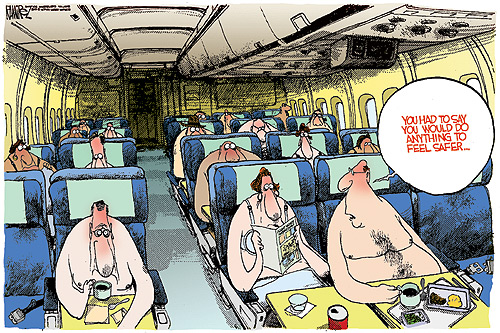
Perfect Solution to Airport Scanning
Here's a solution to all the controversy over full-body scanners.
I think the Transportation Security Adminstration is making things way too complicated.
Have a booth that you can step into that will NOT x-ray you, but will detonate any explosive device you may have on you.
It would be a win-win for everyone. So simple.
I think the Transportation Security Adminstration is making things way too complicated.
Have a booth that you can step into that will NOT x-ray you, but will detonate any explosive device you may have on you.
It would be a win-win for everyone. So simple.
Click on photo to enlarge
Friday, February 12, 2010
The Top Ten Gross Things People Do On Airplanes
We all know about the rare instances of airline passenger misconduct that make it to the headlines, like the case of the naked, angry flyer or the fighting Lohan, but every day little instances of pure gross occur unnoticed or just unreported.
Perhaps you've spotted someone getting a little too frisky beneath their $5 on-board purchase blanket or going about some hygienic business, but chances are you haven't seen all Top Ten Gross Things People Do On Airplanes:
10. Browse dating websites over the in-flight WiFi
We know that having in-flight WiFi is new and great and magical, but it's best to keep your private profile and your preferences for "18/F/Asian" private.
9. Sleep on you/sleep on the floor
It's a long flight back from Hawaii and your seatmate had two too many Mai Tais. Before you can say "Mauna Loa," he's conked out on your shoulder and speedily producing a lava flow of glistening drool.
8. Use the main aisle as a space to do sit-ups, push-ups or change your child's diaper
The aisle is not your gym, nor is it a changing table. No one wants to see your lunging butt centimeters away from them as you attempt calisthenics.
7. Read Hustler, or other "adult" magazines
We realize that airport bookstores and newspaper kiosks sell adult magazines, but that doesn't mean you should immediately "read" them on the plane; those are for after the flight.
6. Attempt to join the Mile High Club
Although it seems flirty and adventurous to get in a mood with your partner and try to see things through while in-flight, keep in mind that you're in a public space.
5. Attempt to join the Mile High Club solo
The provided (or purchsed) airline blanket does not mean you have complete privacy and carte blanche to do what you will underneath it.
4. Eat fried chicken
Don't bring it on a bus, don't bring it on a train, and definitely don't bring it on a plane: smelly, greasy, messy food.
3. Tend to foot hygiene
There are foot fetishists and then there's everyone else. Feet just aren't the sort of thing that you want spending 8 hours a few inches away from the side of your face, especially if they're not your own feet (doing some yoga there?).
2. Vomit into something that is not the supplied barf bag
Thanks. We have a gross image of this in our head: "Saw someone use the plastic wrap from an airline blanket as a barf bag...didn't really work."
1. Sneeze open-mouthed/neglect to wash hands after using lavatory
This in-flight offense takes the number one spot because it happens most frequently and can affect the most passengers.
See more details at: http://bit.ly/ccXhQ7
I just verified the above address and got a warning - probably because the regular address is very long. Don't worrk, it works.
Perhaps you've spotted someone getting a little too frisky beneath their $5 on-board purchase blanket or going about some hygienic business, but chances are you haven't seen all Top Ten Gross Things People Do On Airplanes:
10. Browse dating websites over the in-flight WiFi
We know that having in-flight WiFi is new and great and magical, but it's best to keep your private profile and your preferences for "18/F/Asian" private.
9. Sleep on you/sleep on the floor
It's a long flight back from Hawaii and your seatmate had two too many Mai Tais. Before you can say "Mauna Loa," he's conked out on your shoulder and speedily producing a lava flow of glistening drool.
8. Use the main aisle as a space to do sit-ups, push-ups or change your child's diaper
The aisle is not your gym, nor is it a changing table. No one wants to see your lunging butt centimeters away from them as you attempt calisthenics.
7. Read Hustler, or other "adult" magazines
We realize that airport bookstores and newspaper kiosks sell adult magazines, but that doesn't mean you should immediately "read" them on the plane; those are for after the flight.
6. Attempt to join the Mile High Club
Although it seems flirty and adventurous to get in a mood with your partner and try to see things through while in-flight, keep in mind that you're in a public space.
5. Attempt to join the Mile High Club solo
The provided (or purchsed) airline blanket does not mean you have complete privacy and carte blanche to do what you will underneath it.
4. Eat fried chicken
Don't bring it on a bus, don't bring it on a train, and definitely don't bring it on a plane: smelly, greasy, messy food.
3. Tend to foot hygiene
There are foot fetishists and then there's everyone else. Feet just aren't the sort of thing that you want spending 8 hours a few inches away from the side of your face, especially if they're not your own feet (doing some yoga there?).
2. Vomit into something that is not the supplied barf bag
Thanks. We have a gross image of this in our head: "Saw someone use the plastic wrap from an airline blanket as a barf bag...didn't really work."
1. Sneeze open-mouthed/neglect to wash hands after using lavatory
This in-flight offense takes the number one spot because it happens most frequently and can affect the most passengers.
See more details at: http://bit.ly/ccXhQ7
I just verified the above address and got a warning - probably because the regular address is very long. Don't worrk, it works.
Feds push for tracking cell phones
Two years ago, when the FBI was stymied by a band of armed robbers known as the "Scarecrow Bandits" that had robbed more than 20 Texas banks, it came up with a novel method of locating the thieves.
FBI agents obtained logs from mobile phone companies corresponding to what their cellular towers had recorded at the time of a dozen different bank robberies in the Dallas area. The voluminous records showed that two phones had made calls around the time of all 12 heists, and that those phones belonged to men named Tony Hewitt and Corey Duffey. A jury eventually convicted the duo of multiple bank robbery and weapons charges.
Even though police are tapping into the locations of mobile phones thousands of times a year, the legal ground rules remain unclear, and federal privacy laws written a generation ago are ambiguous at best. On Friday, the first federal appeals court to consider the topic will hear oral arguments (PDF) in a case that could establish new standards for locating wireless devices.
In that case, the Obama administration has argued that warrantless tracking is permitted because Americans enjoy no "reasonable expectation of privacy" in their--or at least their cell phones'--whereabouts. U.S. Department of Justice lawyers say that "a customer's Fourth Amendment rights are not violated when the phone company reveals to the government its own records" that show where a mobile device placed and received calls.
Read more of this interesting story at: http://news.cnet.com/8301-13578_3-10451518-38.html
FBI agents obtained logs from mobile phone companies corresponding to what their cellular towers had recorded at the time of a dozen different bank robberies in the Dallas area. The voluminous records showed that two phones had made calls around the time of all 12 heists, and that those phones belonged to men named Tony Hewitt and Corey Duffey. A jury eventually convicted the duo of multiple bank robbery and weapons charges.
Even though police are tapping into the locations of mobile phones thousands of times a year, the legal ground rules remain unclear, and federal privacy laws written a generation ago are ambiguous at best. On Friday, the first federal appeals court to consider the topic will hear oral arguments (PDF) in a case that could establish new standards for locating wireless devices.
In that case, the Obama administration has argued that warrantless tracking is permitted because Americans enjoy no "reasonable expectation of privacy" in their--or at least their cell phones'--whereabouts. U.S. Department of Justice lawyers say that "a customer's Fourth Amendment rights are not violated when the phone company reveals to the government its own records" that show where a mobile device placed and received calls.
Read more of this interesting story at: http://news.cnet.com/8301-13578_3-10451518-38.html
New Malware Threat for Sale
The global black market for financial services malware now includes a new player, for sale to hackers who want to target the financial credentials of customers of large and mid-sized U.S. banks, according to SecureWorks.
The Atlanta-based online security specialists have given the Trojan the name “Bugat.”
Jason Milletary, a SecureWorks security researcher, said his firm believes the new malware was developed to compete with more costly or hard to buy Trojans such as Zeus and Clampi.
“The emergence of Bugat reinforces that there is a strong demand for new malware to commit financial credential theft and that ACH and wire fraud remains a profitable venture for criminals,” Milletary said.
SecureWorks has posted a research blog note on the find. It’s at www.secureworks.com/research/blog.
The Atlanta-based online security specialists have given the Trojan the name “Bugat.”
Jason Milletary, a SecureWorks security researcher, said his firm believes the new malware was developed to compete with more costly or hard to buy Trojans such as Zeus and Clampi.
“The emergence of Bugat reinforces that there is a strong demand for new malware to commit financial credential theft and that ACH and wire fraud remains a profitable venture for criminals,” Milletary said.
SecureWorks has posted a research blog note on the find. It’s at www.secureworks.com/research/blog.
FSCC awards CUs for stopping over $1.1M in fraud
Financial Service Centers Cooperative (FSCC) announced that it gave awards to 12 credit unions for stopping more than $1.1 million in fraud activity during 2009. The credit unions garnered about 50 Fraud Buster Awards. The awards were presented to credit unions on a quarterly basis during 2009.
Award recipients included credit unions that participate in the FSCC Shared Branching Network. The recipients of the Fraud Buster Awards were recognized for protecting their credit unions, their members, and members of other credit unions from fraud.
FSCC maintains an Operations Advisory Committee comprising of stockholder credit unions. The committee reviews activity and looks at ways to prevent and detect fraud through rule changes, training, products and services. In the nine years the awards have been presented, credit unions have stopped more than $7.5 million from fraudulent activities. FSCC has presented more than 280 awards.
Financial institutions in the U.S. lose about $12 billion a year in check fraud, and the retail industry loses a similar amount resulting in losses of $24 billion as a result of check fraud. The Federal Trade Commission also reports that financial institutions and businesses lose more than $48 billion annually from fraudulent activities, according to statistics FSCC cited from U.S. News and World Report.
Award recipients included credit unions that participate in the FSCC Shared Branching Network. The recipients of the Fraud Buster Awards were recognized for protecting their credit unions, their members, and members of other credit unions from fraud.
FSCC maintains an Operations Advisory Committee comprising of stockholder credit unions. The committee reviews activity and looks at ways to prevent and detect fraud through rule changes, training, products and services. In the nine years the awards have been presented, credit unions have stopped more than $7.5 million from fraudulent activities. FSCC has presented more than 280 awards.
Financial institutions in the U.S. lose about $12 billion a year in check fraud, and the retail industry loses a similar amount resulting in losses of $24 billion as a result of check fraud. The Federal Trade Commission also reports that financial institutions and businesses lose more than $48 billion annually from fraudulent activities, according to statistics FSCC cited from U.S. News and World Report.
Thursday, February 11, 2010
ID Theft at All-Time High
The number of identity fraud victims in the U.S. increased 12% to 11.1 million adults in 2009--the highest increase since 2003, according to a new ID theft study. The total annual fraud amount increased by 12.5% to $54 billion.
The high is probably due to the economic downturn, Javelin Strategy and Research said in its study, "The 2010 Identity Fraud Survey Report," which was co-sponsored by Intersections, a CUNA Strategic Service, that specializes in I.D. theft prevention services.
Average fraud resolution time dropped 30% to 21 hours. Nearly half of new victims file police reports, resulting in double the reported arrests, triple the prosecutions and double the percentage of convictions in 2009.
Thirty-nine percent of identity fraud victims reported fraudulent new credit card accounts, up from 33% in 2008. New online accounts opened fraudulently more than doubled over 2008, and the number of new e-mail payment accounts increased 12%.
Financial services companies continue to excel in detecting fraud and alerting their customers. More than one-third of victims first learned about the fraud from their financial institution, the report said.
Other findings:
> Identification most likely to be compromised in a data breach continues to be full name (63%) and physical address (37%). Compromised health insurance information increased 4% over the last year.
> About 75% of existing card fraud incidents came from credit cards, an increase of 12% over 2008. Existing debit cards fraud incidents represented 33% of total existing card fraud in 2009 and decreased by 2%.
> Eighteen to 24-year-olds are the slowest to detect fraud--they take nearly twice as many days to detect it as other age groups. They were found to be less likely to monitor accounts regularly and the least likely group to take advantage of monitoring programs offered by financial institutions. However, they are the most likely group to take action such as switching primary institutions or switching forms of payment if fraud occurs.
> Identity fraud victims in the U.S. grew to 4.8% of the population, with a projected total of $54 billion in crime.
> Small business owners suffer fraud at one-and-a-half times the rate of other adults, because small office and home office business owners use personal accounts when making business transactions and make more transactions than typical adults.
"Identity fraud continues on the upswing, and we believe it will continue to rise if consumers fail to take proactive steps to prevent fraudsters from taking advantage of their offline and online transactions and their increasingly exposed personal information on social networks," said Michael Stanfield, Intersections chairman/CEO. "In addition, consumers need to protect themselves and their computers from sophisticated malware, and well-conceived and executed spam and phishing attacks."
Intersections offered several tips to reduce identity fraud, including the use of direct deposit, installing software to protect against viruses and spyware, turning off Bluetooth or Wi-Fi when not in use, monitoring accounts weekly, and acting quickly when fraud is suspected.
The high is probably due to the economic downturn, Javelin Strategy and Research said in its study, "The 2010 Identity Fraud Survey Report," which was co-sponsored by Intersections, a CUNA Strategic Service, that specializes in I.D. theft prevention services.
Average fraud resolution time dropped 30% to 21 hours. Nearly half of new victims file police reports, resulting in double the reported arrests, triple the prosecutions and double the percentage of convictions in 2009.
Thirty-nine percent of identity fraud victims reported fraudulent new credit card accounts, up from 33% in 2008. New online accounts opened fraudulently more than doubled over 2008, and the number of new e-mail payment accounts increased 12%.
Financial services companies continue to excel in detecting fraud and alerting their customers. More than one-third of victims first learned about the fraud from their financial institution, the report said.
Other findings:
> Identification most likely to be compromised in a data breach continues to be full name (63%) and physical address (37%). Compromised health insurance information increased 4% over the last year.
> About 75% of existing card fraud incidents came from credit cards, an increase of 12% over 2008. Existing debit cards fraud incidents represented 33% of total existing card fraud in 2009 and decreased by 2%.
> Eighteen to 24-year-olds are the slowest to detect fraud--they take nearly twice as many days to detect it as other age groups. They were found to be less likely to monitor accounts regularly and the least likely group to take advantage of monitoring programs offered by financial institutions. However, they are the most likely group to take action such as switching primary institutions or switching forms of payment if fraud occurs.
> Identity fraud victims in the U.S. grew to 4.8% of the population, with a projected total of $54 billion in crime.
> Small business owners suffer fraud at one-and-a-half times the rate of other adults, because small office and home office business owners use personal accounts when making business transactions and make more transactions than typical adults.
"Identity fraud continues on the upswing, and we believe it will continue to rise if consumers fail to take proactive steps to prevent fraudsters from taking advantage of their offline and online transactions and their increasingly exposed personal information on social networks," said Michael Stanfield, Intersections chairman/CEO. "In addition, consumers need to protect themselves and their computers from sophisticated malware, and well-conceived and executed spam and phishing attacks."
Intersections offered several tips to reduce identity fraud, including the use of direct deposit, installing software to protect against viruses and spyware, turning off Bluetooth or Wi-Fi when not in use, monitoring accounts weekly, and acting quickly when fraud is suspected.
Tuesday, February 9, 2010
CURE 1-Year Old
Credit Union Retired Executives (CURE), at http://www.curetiredexecs.com/ is pleased to announce the celebration of the 1st anniversary of its unique new online service, which offers free and confidential advice that is tailored to questions from credit union professionals.
During this inaugural year, the 26 Advisors have answered more than 250 questions from credit union professionals nationwide.
Friday, February 5, 2010
What can private corporations do to employees? Just about everything
Toni Bowers with Tech Republic writes an interesting. Details are at: http://blogs.techrepublic.com.com/career/?p=1706&tag=nl.e101
In his new book Can they do that?, Lewis Maltby says that employees are often surprised at the reasons over which they can be fired.
With all that you hear today in the news about employees suing former employers, you’d think that it would be very difficult for an employer to actually fire someone. But the reality is different in the private sector.
In a recent interview on NPR, Maltby said, “Freedom of speech is protected by the First Amendment - but only where the government is concerned. What most Americans generally don’t know is that the Constitution doesn’t apply to private corporations at all.”
Private corporations can fire someone for almost anything. Maltby related an incident when a worker was fired for having a bumper sticker that expressed a political view that did not jibe with the CEO’s.
The only thing that a corporation cannot do is eavesdrop on a personal oral conversation. Anything else, Maltby said, “is open season.”
I’ve written before about how employers-potential and existing-are within legal limits to peruse individuals’ personal blogs or Facebook pages, and to watch what you put there. Maltby says employers do this regularly and can fire someone over what they see.
And it doesn’t stop there. In his book, Maltby relates stories of employer abuses that include tracking employees through cell phone GPS locators to placing hidden cameras in restrooms. He says that 20% of employers now require employees to agree before being hired not to go to court if the corporation violates their legal rights.
While most people would agree that a private company has the right to run itself any way it sees fit, you can see how this right could be abused. Maltby is pushing for the Bill of Rights to apply to the private sector. In the book appendixes, he provides sample letters to elected representatives and human rights organizations as well as an Employee Bill of Rights.
In his new book Can they do that?, Lewis Maltby says that employees are often surprised at the reasons over which they can be fired.
With all that you hear today in the news about employees suing former employers, you’d think that it would be very difficult for an employer to actually fire someone. But the reality is different in the private sector.
In a recent interview on NPR, Maltby said, “Freedom of speech is protected by the First Amendment - but only where the government is concerned. What most Americans generally don’t know is that the Constitution doesn’t apply to private corporations at all.”
Private corporations can fire someone for almost anything. Maltby related an incident when a worker was fired for having a bumper sticker that expressed a political view that did not jibe with the CEO’s.
The only thing that a corporation cannot do is eavesdrop on a personal oral conversation. Anything else, Maltby said, “is open season.”
I’ve written before about how employers-potential and existing-are within legal limits to peruse individuals’ personal blogs or Facebook pages, and to watch what you put there. Maltby says employers do this regularly and can fire someone over what they see.
And it doesn’t stop there. In his book, Maltby relates stories of employer abuses that include tracking employees through cell phone GPS locators to placing hidden cameras in restrooms. He says that 20% of employers now require employees to agree before being hired not to go to court if the corporation violates their legal rights.
While most people would agree that a private company has the right to run itself any way it sees fit, you can see how this right could be abused. Maltby is pushing for the Bill of Rights to apply to the private sector. In the book appendixes, he provides sample letters to elected representatives and human rights organizations as well as an Employee Bill of Rights.
Technology Brings Double-Digit CU Member Growth to Mexico
Technology Does Pay. Believe me.
Thanks to the installation of high-powered computer servers and the use of handheld transaction devices like PDAs, Mexican credit union Caja Yanga is experiencing a 15% monthly growth rate.
In anticipation of the launch of Caja Yanga's first ATMs last month, the credit union installed a new information technology infrastructure and moved its principal data center. In addition to bringing the credit union into compliance with federal regulations, the move drastically improved data transfer efficiency, providing the capacity to support projected growth.
The credit union also implemented a WOCCU outreach model in which field officers bring savings-focused financial services to members on foot or motorcycle and use PDAs to conduct transactions and transmit data. Last year, field officers performed 80,960 PDA-based financial transactions for remote members.
Thanks to the installation of high-powered computer servers and the use of handheld transaction devices like PDAs, Mexican credit union Caja Yanga is experiencing a 15% monthly growth rate.
In anticipation of the launch of Caja Yanga's first ATMs last month, the credit union installed a new information technology infrastructure and moved its principal data center. In addition to bringing the credit union into compliance with federal regulations, the move drastically improved data transfer efficiency, providing the capacity to support projected growth.
The credit union also implemented a WOCCU outreach model in which field officers bring savings-focused financial services to members on foot or motorcycle and use PDAs to conduct transactions and transmit data. Last year, field officers performed 80,960 PDA-based financial transactions for remote members.
Thursday, February 4, 2010
In The News The Year You Were Born
Click on the year you were born and read the news for that year.
http://www.oldhippie.com/forums/ice-house/8883-news-year-you-were-born.html
Monday, February 1, 2010
CU Information Security Conference Set for May 19-21
One of the biggest needs in credit unions today is security. The 10th annual credit union security conference is set for May 19-21, 2010 at the Red Rock Resort in Las Vegas. This popular conference offers one of the highest dollar values of any other conference serving credit unions. Your registration fee includes the first two nights lodging FREE - No Extra Cost. Check out the program agenda, schedule, a site visit to an area credit union, speakers and more at: http://bit.ly/cusecurity2010. Sunday, January 31, 2010
January News & Views Published Below
CU SECURITY & TECHNOLOGY News - Providing a brief summary of news and information related to security and technology issues for credit unions - Plus some interesting and fun web sites . . .
Friday, January 22, 2010
If Your Password Is 123456, You May Be In Trouble
Back at the dawn of the Web, the most popular account password was "12345."
Today, it's one digit longer but hardly safer: "123456."
Despite all the reports of Internet security breaches over the years, including the recent attacks on Google's e-mail service, many people have reacted to the break-ins with a shrug.
According to a new analysis, one out of five Web users still decides to leave the digital equivalent of a key under the doormat: they choose a simple, easily guessed password like "abc123," "iloveyou" or even "password" to protect their data.
"I guess it's just a genetic flaw in humans," said Amichai Shulman, the chief technology officer at Imperva, which makes software for blocking hackers. "We've been following the same patterns since the 1990s."
Mr. Shulman and his company examined a list of 32 million passwords that an unknown hacker stole last month from RockYou, a company that makes software for users of social networking sites like Facebook and MySpace. The list was briefly posted on the Web, and hackers and security researchers downloaded it. (RockYou, which had already been widely criticized for lax privacy practices, has advised its customers to change their passwords, as the hacker gained information about their e-mail accounts as well.)
The trove provided an unusually detailed window into computer users' password habits. Typically, only government agencies like the F.B.I. or the National Security Agency have had access to such a large password list.
"This was the mother lode," said Matt Weir, a doctoral candidate in the e-crimes and investigation technology lab at Florida State University, where researchers are also examining the data.
Imperva found that nearly 1 percent of the 32 million people it studied had used "123456" as a password. The second-most-popular password was "12345." Others in the top 20 included "qwerty," "abc123" and "princess."
More disturbing, said Mr. Shulman, was that about 20 percent of people on the RockYou list picked from the same, relatively small pool of 5,000 passwords.
That suggests that hackers could easily break into many accounts just by trying the most common passwords. Because of the prevalence of fast computers and speedy networks, hackers can fire off thousands of password guesses per minute.
"We tend to think of password guessing as a very time-consuming attack in which I take each account and try a large number of name-and-password combinations," Mr. Shulman said. "The reality is that you can be very effective by choosing a small number of common passwords."
Some Web sites try to thwart the attackers by freezing an account for a certain period of time if too many incorrect passwords are typed. But experts say that the hackers simply learn to trick the system, by making guesses at an acceptable rate, for instance.
To improve security, some Web sites are forcing users to mix letters, numbers and even symbols in their passwords. Others, like Twitter, prevent people from picking common passwords.
Today, it's one digit longer but hardly safer: "123456."
Despite all the reports of Internet security breaches over the years, including the recent attacks on Google's e-mail service, many people have reacted to the break-ins with a shrug.
According to a new analysis, one out of five Web users still decides to leave the digital equivalent of a key under the doormat: they choose a simple, easily guessed password like "abc123," "iloveyou" or even "password" to protect their data.
"I guess it's just a genetic flaw in humans," said Amichai Shulman, the chief technology officer at Imperva, which makes software for blocking hackers. "We've been following the same patterns since the 1990s."
Mr. Shulman and his company examined a list of 32 million passwords that an unknown hacker stole last month from RockYou, a company that makes software for users of social networking sites like Facebook and MySpace. The list was briefly posted on the Web, and hackers and security researchers downloaded it. (RockYou, which had already been widely criticized for lax privacy practices, has advised its customers to change their passwords, as the hacker gained information about their e-mail accounts as well.)
The trove provided an unusually detailed window into computer users' password habits. Typically, only government agencies like the F.B.I. or the National Security Agency have had access to such a large password list.
"This was the mother lode," said Matt Weir, a doctoral candidate in the e-crimes and investigation technology lab at Florida State University, where researchers are also examining the data.
Imperva found that nearly 1 percent of the 32 million people it studied had used "123456" as a password. The second-most-popular password was "12345." Others in the top 20 included "qwerty," "abc123" and "princess."
More disturbing, said Mr. Shulman, was that about 20 percent of people on the RockYou list picked from the same, relatively small pool of 5,000 passwords.
That suggests that hackers could easily break into many accounts just by trying the most common passwords. Because of the prevalence of fast computers and speedy networks, hackers can fire off thousands of password guesses per minute.
"We tend to think of password guessing as a very time-consuming attack in which I take each account and try a large number of name-and-password combinations," Mr. Shulman said. "The reality is that you can be very effective by choosing a small number of common passwords."
Some Web sites try to thwart the attackers by freezing an account for a certain period of time if too many incorrect passwords are typed. But experts say that the hackers simply learn to trick the system, by making guesses at an acceptable rate, for instance.
To improve security, some Web sites are forcing users to mix letters, numbers and even symbols in their passwords. Others, like Twitter, prevent people from picking common passwords.
For more information from this article, Visit the NY Times at:
Wednesday, January 20, 2010
A Frequent Traveler Jacket
How about a frequent travelers jacket with 22 pockets as a purposeful carry-on. Breeze thru security. Just slip off the vest. Comes in three colors. Not a bad idea.
Check out more details and information at: http://www.scottevest.com/
Monday, January 18, 2010
The Rollup PC - You Won't Believe Your Eyes
Check out the laptop of the future - The Rollup.
See more at: http://orkin-design.de/design/rolltop/movie/FXVideo_Example.html
or at: http://manneli.com/movies/Laptop.html
The wave of the future.
See more at: http://orkin-design.de/design/rolltop/movie/FXVideo_Example.html
or at: http://manneli.com/movies/Laptop.html
The wave of the future.
Sunday, January 17, 2010
Use Wasp Spray Instead of Pepper Spray
A friend who is a receptionist in a church in a high risk area was concerned about someone coming into the office on Monday to rob them when they were counting the collection. She asked the local police department about using pepper spray and they recommended to her that she get a can of wasp spray instead.
The wasp spray, they told her, can shoot up to twenty feet away and is a lot more accurate, while with the pepper spray, they have to get too close to you and could overpower you. The wasp spray temporarily blinds an attacker until they get to the hospital for an antidote.
It's also one he wants everyone to hear. If you're looking for protection, Glinka says look to the spray. "That's going to give you a chance to call the police; maybe get out." Maybe even save a life.
The wasp spray, they told her, can shoot up to twenty feet away and is a lot more accurate, while with the pepper spray, they have to get too close to you and could overpower you. The wasp spray temporarily blinds an attacker until they get to the hospital for an antidote.
She keeps a can on her desk in the office and it doesn't attract attention from people like a can of pepper spray would. She also keeps one nearby at home for home protection. Thought this was interesting and might be of use.
On the heels of a break in and beating that left an elderly woman in Toledo dead, self defense experts have a tip that could save your life.
Val Glinka teaches self-defense to students at Sylvania Southview High School . For decades, he's suggested putting a can of wasp and hornet spray near your door or bed. Glinka says, "This is better than anything I can teach them." Glinka considers it inexpensive, easy to find, and more effective than mace or pepper spray.
The cans typically shoot 20 to 30 feet; so if someone tries to break into your home, Glinka says "spray the culprit in the eyes". It's a tip he's given to students for decades.
Five Robberies in Five Years; CU Closes Branch
After enduring five robberies in five years, workers at A-K Valley Federal Credit Union in the Pittsburgh area cleaned out their crime-plagued Homewood branch -- never to reopen.
"We just decided we'd had it," said Janet Horn, chief executive of the credit union, regarding the latest incident New Year's Day at the two-story brick office.
The Homewood branch had been robbed by criminals bearing assault rifles on four previous occasions since mid-2004, when the credit union opened there. This time, the credit union's board voted Jan. 5 to shutter the branch, which served 1,630 members.
More on this story at: http://www.pittsburghlive.com/x/pittsburghtrib/business/s_662505.html
"We just decided we'd had it," said Janet Horn, chief executive of the credit union, regarding the latest incident New Year's Day at the two-story brick office.
The Homewood branch had been robbed by criminals bearing assault rifles on four previous occasions since mid-2004, when the credit union opened there. This time, the credit union's board voted Jan. 5 to shutter the branch, which served 1,630 members.
More on this story at: http://www.pittsburghlive.com/x/pittsburghtrib/business/s_662505.html
Oxymorons at Play
Beyond the classic definition of oxymoron, there may be at least two others in my never finished complete Dictionary of Words as We Phonetically Understand them. Take a look:
(1) Oxymoron. (noun) definitions: (1) any expression in words or placement of objects or combination of both that conveys a contradictory meaning; (2) the dumbest guy at Oxford; (3) anyone who fails to grasp the cleansing power of Oxydol soap after seventy years of its broad commercial exposure to one and all.
That first one was mine, but I can neither take nor offer credit for the rest of these items on the list below because they came to me via e-mail with a lot of beautiful graphics and no acknowledgement of authorship by a living or deceased soul. Some of these figures of speech have been around these parts for a very long time so I suspect that even this list is little more than a collection of “oxy-morons” from all those places on this electronic planet where jokes and whimsy pop up as often and surprisingly as those little life-energy lightning bugs of Pandora in the movie “Avatar”.
Here’s the Sunday Working Day of Rest List of All the Rest:
(2) Is it good if a vacuüm really sucks?
(3) Why is the third hand on the watch called the second-hand?
(4) If a word is misspelled in the dictionary, how would we ever know?
(5) If Webster wrote the first dictionary, where did he find the words?
(6) Why does “slow down” and “slow up” mean the same thing?
(7) Why does “fat chance” and “slim chance” mean the same thing?
(8) Why do “tug” boats push their barges?
(9) Why do we sing “Take Me Out To The Ballgame” when we are already there?
(10) Why are the benches and chairs at the ballpark called “stands” when they are made for sitting?
(11) Why do we say an evening time for something is “after dark” when it is really “after light”?
(12) Doesn’t “expect the unexpected” make the unexpected expected?
(13) Why are a “wise man” and a “wise guy” perceived as opposites?
(14) Why do “overlook” and “oversee” mean opposite applications of attention?
(15) Why is “phonics” not spelled the way it sounds?
(16) If work is so good for you, why do they have to pay you to do it?
(17) If all the world’s a stage, where is the audience sitting?
(18) If love is blind, why is lingerie so popular?
(19) If you are cross-eyed, but you also have dyslexia, can you read all right?
(20) Why is a “bra” singular and “panties” plural?
(21) Why do we press harder on the buttons of a remote control when we know the batteries are dying or dead?
(22) Why do we put suits in garment bags and garments in a suitcase?
(23) How come “abbreviated” is such a long word?
(24) Why do we wash bath towels? Aren’t we clean when we use them?
(25) Why doesn’t glue stick to the inside of the bottle?
(26) Why do we drive on a parkway, but we park on a driveway?
(1) Oxymoron. (noun) definitions: (1) any expression in words or placement of objects or combination of both that conveys a contradictory meaning; (2) the dumbest guy at Oxford; (3) anyone who fails to grasp the cleansing power of Oxydol soap after seventy years of its broad commercial exposure to one and all.
That first one was mine, but I can neither take nor offer credit for the rest of these items on the list below because they came to me via e-mail with a lot of beautiful graphics and no acknowledgement of authorship by a living or deceased soul. Some of these figures of speech have been around these parts for a very long time so I suspect that even this list is little more than a collection of “oxy-morons” from all those places on this electronic planet where jokes and whimsy pop up as often and surprisingly as those little life-energy lightning bugs of Pandora in the movie “Avatar”.
Here’s the Sunday Working Day of Rest List of All the Rest:
(2) Is it good if a vacuüm really sucks?
(3) Why is the third hand on the watch called the second-hand?
(4) If a word is misspelled in the dictionary, how would we ever know?
(5) If Webster wrote the first dictionary, where did he find the words?
(6) Why does “slow down” and “slow up” mean the same thing?
(7) Why does “fat chance” and “slim chance” mean the same thing?
(8) Why do “tug” boats push their barges?
(9) Why do we sing “Take Me Out To The Ballgame” when we are already there?
(10) Why are the benches and chairs at the ballpark called “stands” when they are made for sitting?
(11) Why do we say an evening time for something is “after dark” when it is really “after light”?
(12) Doesn’t “expect the unexpected” make the unexpected expected?
(13) Why are a “wise man” and a “wise guy” perceived as opposites?
(14) Why do “overlook” and “oversee” mean opposite applications of attention?
(15) Why is “phonics” not spelled the way it sounds?
(16) If work is so good for you, why do they have to pay you to do it?
(17) If all the world’s a stage, where is the audience sitting?
(18) If love is blind, why is lingerie so popular?
(19) If you are cross-eyed, but you also have dyslexia, can you read all right?
(20) Why is a “bra” singular and “panties” plural?
(21) Why do we press harder on the buttons of a remote control when we know the batteries are dying or dead?
(22) Why do we put suits in garment bags and garments in a suitcase?
(23) How come “abbreviated” is such a long word?
(24) Why do we wash bath towels? Aren’t we clean when we use them?
(25) Why doesn’t glue stick to the inside of the bottle?
(26) Why do we drive on a parkway, but we park on a driveway?
Thursday, January 14, 2010
FBI issues Haitian relief fraud alert
Internet users who receive appeals to donate funds in the aftermath of the recent earthquake in Haiti need to perform their due diligence before responding to the requests, said the Federal Bureau of Investigation (FBI).
Credit unions might want to warn members that past tragedies and natural disasters have prompted criminals to solicit contributions that they claim are for a charitable organization or a good cause.
Before making any donation, consumers should use these guidelines, said the FBI.
Do not respond to any unsolicited (spam) incoming e-mails, including clicking links contained within the messages;
Be skeptical of individuals representing themselves as surviving victims or officials asking for donations via e-mail or social networking sites;
Verify the legitimacy of nonprofit organizations by using Internet-based resources to assist in confirming the group's existence and its nonprofit status rather than following a purported link to the site;
Be cautious of e-mails that claim to show photos of the disaster areas in attached files because these files may contain viruses. Only open attachments from known senders;
Make contributions directly to known organizations rather than relying on others to make the donation on your behalf to ensure contributions are received and used for intended purposes; and
Do not give personal or financial information to anyone soliciting contributions; providing that information may compromise your identity and make you vulnerable to identity theft.
The agency said anyone receiving a suspicious e-mail or anyone who becomes a victim of such incidents should notify the Internet Crime Complaint Center, known as IC3.
Credit unions might want to warn members that past tragedies and natural disasters have prompted criminals to solicit contributions that they claim are for a charitable organization or a good cause.
Before making any donation, consumers should use these guidelines, said the FBI.
Do not respond to any unsolicited (spam) incoming e-mails, including clicking links contained within the messages;
Be skeptical of individuals representing themselves as surviving victims or officials asking for donations via e-mail or social networking sites;
Verify the legitimacy of nonprofit organizations by using Internet-based resources to assist in confirming the group's existence and its nonprofit status rather than following a purported link to the site;
Be cautious of e-mails that claim to show photos of the disaster areas in attached files because these files may contain viruses. Only open attachments from known senders;
Make contributions directly to known organizations rather than relying on others to make the donation on your behalf to ensure contributions are received and used for intended purposes; and
Do not give personal or financial information to anyone soliciting contributions; providing that information may compromise your identity and make you vulnerable to identity theft.
The agency said anyone receiving a suspicious e-mail or anyone who becomes a victim of such incidents should notify the Internet Crime Complaint Center, known as IC3.
Wednesday, January 13, 2010
Malware hits online banking, Google's online apps market
Credit unions sounded the alarm that suspicious applications downloaded from Google's Android Market for cellphones may have stolen users' online banking information. And the Credit Union Information Security Professionals Association (CUISPA) is alerting credit unions to a fraud attempt in the online banking arena.
BayPort CU, a $1.1 billion credit union in Newport News, Va., and First Tech CU of Beaverton, Ore., issued warnings on Dec. 22 about a rogue Android application on Google's online market that promised members easy access to their online banking (Computerworld Jan. 12 and iPhone Central Jan. 11).
"It is believed that fraudsters deployed fraudulent mobile banking applications to the Android Marketplace, using a phishing technique to attempt to gain access to mobile banking users' financial information," said BayPort's alert.
The suspicious application creates mobile banking apps that members and other users can download to their phones but actually have the ability to steal information. Those who have added the apps should go to their mobile service provider to make ensure the suspicious apps are removed for good.
BayPort said it notified Google, and Google removed the program plus 50 similar apps, all written by a single developer identified as "09Droid."
However, security researchers have not confirmed whether the Android apps were actually malicious because before they could get copies of the suspicious apps, Google removed them from the market, according to ComputerWorld. The apps could just be someone using a shortcut app to make a quick buck, said the researchers.
Google does not vet its Android applications that appear on its online store. Apple runs its App Store for the iPhone and has an approval process for mobile applications.
Another kind of fraud in online banking--the Zeus or Zbot--was the topic of warning from CUISPA.
The Zbot is a "particularly nasty malware that is bypassing top antivirus/Malware scanners and compromising member accounts," said CUISPA's alert. "Cases have been identified by dozens of credit unions, that we know of. One can assume it is far more widespread than we've currently seen," said Kelly Dowell, executive director at CUISPA.
"The malware infects desktops the same way viruses do, but once infected it is very difficult to remove. Initial reports have come in from credit union members that logged into online banking and received a display page asking for additional authentication in the form of credit card information. The key here is the page was displayed after logging into their home banking accounts," said Dowell.
"It's important to understand that if the user is seeing that page, the damage is done. The online banking credentials have been compromised and need to be changed immediately," Dowell explained.
"The nasty thing about Zeus/Zbot is how it has been morphing or evolving," said Dowell, adding that it hides its presence on the member's machine. It is the same attack that is behind a recent flurry of automated clearinghouse (ACH) fraud.
BayPort CU, a $1.1 billion credit union in Newport News, Va., and First Tech CU of Beaverton, Ore., issued warnings on Dec. 22 about a rogue Android application on Google's online market that promised members easy access to their online banking (Computerworld Jan. 12 and iPhone Central Jan. 11).
"It is believed that fraudsters deployed fraudulent mobile banking applications to the Android Marketplace, using a phishing technique to attempt to gain access to mobile banking users' financial information," said BayPort's alert.
The suspicious application creates mobile banking apps that members and other users can download to their phones but actually have the ability to steal information. Those who have added the apps should go to their mobile service provider to make ensure the suspicious apps are removed for good.
BayPort said it notified Google, and Google removed the program plus 50 similar apps, all written by a single developer identified as "09Droid."
However, security researchers have not confirmed whether the Android apps were actually malicious because before they could get copies of the suspicious apps, Google removed them from the market, according to ComputerWorld. The apps could just be someone using a shortcut app to make a quick buck, said the researchers.
Google does not vet its Android applications that appear on its online store. Apple runs its App Store for the iPhone and has an approval process for mobile applications.
Another kind of fraud in online banking--the Zeus or Zbot--was the topic of warning from CUISPA.
The Zbot is a "particularly nasty malware that is bypassing top antivirus/Malware scanners and compromising member accounts," said CUISPA's alert. "Cases have been identified by dozens of credit unions, that we know of. One can assume it is far more widespread than we've currently seen," said Kelly Dowell, executive director at CUISPA.
"The malware infects desktops the same way viruses do, but once infected it is very difficult to remove. Initial reports have come in from credit union members that logged into online banking and received a display page asking for additional authentication in the form of credit card information. The key here is the page was displayed after logging into their home banking accounts," said Dowell.
"It's important to understand that if the user is seeing that page, the damage is done. The online banking credentials have been compromised and need to be changed immediately," Dowell explained.
"The nasty thing about Zeus/Zbot is how it has been morphing or evolving," said Dowell, adding that it hides its presence on the member's machine. It is the same attack that is behind a recent flurry of automated clearinghouse (ACH) fraud.
Thursday, January 7, 2010
Craig's List ad targeting CUs is pulled
Craig's List has pulled an advertisement that sought to recruit current credit union members to solicit others to join the credit union through them.
According to the Pennsylvania Credit Union Association (PCUA), the advertiser offered $75 to current members who answered the ad and allowed ineligible people to join credit unions through a current member (Life is a Highway Jan. 6).
The ad listed specific credit unions across the country. However, the wording indicated the ad would take anyone, said PCUA.
The ad appeared to be from California. PCUA alerted the California Credit Union League, which investigated the posting. When News Now went to check the link, Craig's List had posted a notice that it had pulled the ad.
According to the Pennsylvania Credit Union Association (PCUA), the advertiser offered $75 to current members who answered the ad and allowed ineligible people to join credit unions through a current member (Life is a Highway Jan. 6).
The ad listed specific credit unions across the country. However, the wording indicated the ad would take anyone, said PCUA.
The ad appeared to be from California. PCUA alerted the California Credit Union League, which investigated the posting. When News Now went to check the link, Craig's List had posted a notice that it had pulled the ad.
Monday, January 4, 2010
Scams Were Rampant in December
An off-shore e-mail scam targeting members and nonmembers of a Michigan-based credit union made its way to Wisconsin recently--one of several scams credit unions reported during the holiday season.
The scam targeted Community Driven CU, Ypsilanti, Mich., and spread to consumers in Wisconsin and in Texas, the Kenosha News reported (Dec. 21). A reporter of that publication received a bogus e-mail purporting to be from the Michigan credit union, asking the reporter to enter in a credit card account number and personal identification number to view a Visa card statement.
Mary Cole, Community Driven CU member service loan officer, said the credit union is aware of the scam and has received many phone calls about it. The credit union also was hit by a text-messaging scam in November, she told the newspaper.
Washington Post columnist Elizabeth Razzi noted in a Dec. 15 column that she and her daughter received a text message saying that their ATM cards had been suspended from Treasury Department FCU, Washington, D.C. After receiving the message, Razzi visited the credit union's website and saw that a scam warning had been posted.
Read more at: http://www.cuna.org/newsnow/10/system123109-2.html?ref=hed
The scam targeted Community Driven CU, Ypsilanti, Mich., and spread to consumers in Wisconsin and in Texas, the Kenosha News reported (Dec. 21). A reporter of that publication received a bogus e-mail purporting to be from the Michigan credit union, asking the reporter to enter in a credit card account number and personal identification number to view a Visa card statement.
Mary Cole, Community Driven CU member service loan officer, said the credit union is aware of the scam and has received many phone calls about it. The credit union also was hit by a text-messaging scam in November, she told the newspaper.
Washington Post columnist Elizabeth Razzi noted in a Dec. 15 column that she and her daughter received a text message saying that their ATM cards had been suspended from Treasury Department FCU, Washington, D.C. After receiving the message, Razzi visited the credit union's website and saw that a scam warning had been posted.
Read more at: http://www.cuna.org/newsnow/10/system123109-2.html?ref=hed
Wednesday, December 30, 2009
Things That Have Gone Away: Remember These?
Adjusting Rabbit Ears On Top Of a TV
Adjusting Horizontal And Vertical Holds on a TV
Be Kind-Rewind video tapes
Calling A Phone Sex Line
Calling Collect On A Payphone
Cash Register Used Manually Entering The Prices (rather than scanning them)
Changing The Ribbon On A Typewriter
Converting Your Albums From Vinyl To Cassette Tape
Cuff Links
Dialing A Rotary Phone
Filing Cards In A Library Card Catalog
Finding Channels On UHF
Getting Off The Couch To Change Channels On Your TV Set
Having Your Gas Pumped For You And Your Oil Checked At A Full-service Gas Station
Kick Starting A Motorcycle
Knowing What Part Of Town Someone Lives In By Their Phone Exchange
Loading A Reel To Reel Tape Drive
Making An Operator Assisted Phone Call
Making Hot Chocolate By Heating Milk in a Pan, Then Adding Cocoa Powder and Sugar (remember the "skin" on the milk?)
Meeting People By Answering Personal Ads In A Newspaper Or Magazine
Opening A Can Of Beer Or Soda With A Church Key
Peeling The Developer Layer Off A Polaroid
Percolating Coffee
Placing A Coin On A Tone arm To Prevent Skipping
Popping Corn In A Pot With Oil
Porn Not From The Internet
Putting A Needle On A Vinyl Record
Rewinding An Audio Cassette Using A Bic Pen
Selling Something In The Classified Ads
Shave With A Straight Razor
Shorthand
Smelling A Freshly Mimeographed Test Paper
Switching To High Beams By Stomping On A Button In The Floor
Taking The Tape Out Of An Answering Machine
Testing TV Tubes At the Drugstore
Using Carbon Paper To Make Copies
Using Correction Fluid
Using A Party-line Telephone
Using A Pay Toilet
Adjusting Horizontal And Vertical Holds on a TV
Be Kind-Rewind video tapes
Calling A Phone Sex Line
Calling Collect On A Payphone
Cash Register Used Manually Entering The Prices (rather than scanning them)
Changing The Ribbon On A Typewriter
Converting Your Albums From Vinyl To Cassette Tape
Cuff Links
Dialing A Rotary Phone
Filing Cards In A Library Card Catalog
Finding Channels On UHF
Getting Off The Couch To Change Channels On Your TV Set
Having Your Gas Pumped For You And Your Oil Checked At A Full-service Gas Station
Kick Starting A Motorcycle
Knowing What Part Of Town Someone Lives In By Their Phone Exchange
Loading A Reel To Reel Tape Drive
Making An Operator Assisted Phone Call
Making Hot Chocolate By Heating Milk in a Pan, Then Adding Cocoa Powder and Sugar (remember the "skin" on the milk?)
Meeting People By Answering Personal Ads In A Newspaper Or Magazine
Opening A Can Of Beer Or Soda With A Church Key
Peeling The Developer Layer Off A Polaroid
Percolating Coffee
Placing A Coin On A Tone arm To Prevent Skipping
Popping Corn In A Pot With Oil
Porn Not From The Internet
Putting A Needle On A Vinyl Record
Rewinding An Audio Cassette Using A Bic Pen
Selling Something In The Classified Ads
Shave With A Straight Razor
Shorthand
Smelling A Freshly Mimeographed Test Paper
Switching To High Beams By Stomping On A Button In The Floor
Taking The Tape Out Of An Answering Machine
Testing TV Tubes At the Drugstore
Using Carbon Paper To Make Copies
Using Correction Fluid
Using A Party-line Telephone
Using A Pay Toilet
Gadgets of the Decade
2000: The USB Flash Drive
2001: The iPod
2002: The Dyson DC07 Vacuum Cleaner
2003: The Mainstream DVR
2004: The Motorola RAZR Cell Phone
2005: Personal GPS Navigation Devices
2006: Intel-Powered Macbooks
2007: Tie - the iPhone, the Wii, and the Flip camera
2008: Netbooks
2009: Explosion of e-readers
See the entire list and read the details at: http://www.fastcompany.com/pics/gadgets-decade
2001: The iPod
2002: The Dyson DC07 Vacuum Cleaner
2003: The Mainstream DVR
2004: The Motorola RAZR Cell Phone
2005: Personal GPS Navigation Devices
2006: Intel-Powered Macbooks
2007: Tie - the iPhone, the Wii, and the Flip camera
2008: Netbooks
2009: Explosion of e-readers
See the entire list and read the details at: http://www.fastcompany.com/pics/gadgets-decade
Tuesday, December 29, 2009
December News & Views Published Below
CU SECURITY & TECHNOLOGY News - Providing a brief summary of news and information related to security and technology issues for credit unions - Plus some interesting and fun web sites . . .
Monday, December 28, 2009
Five technology trends to watch in 2010
Technology innovation continued its ruthless pace in 2009, despite the economic headwinds. Now it’s time to turn our sights on 2010, where there are going to be some really interesting things to keep an eye on. Let’s count down the five tech trends that should be on your radar for 2010.
5: The consumerization of IT - This is something we’ve been talking about for a couple years but the trend is accelerating. We see it in employees using their own personal laptops and devices for work tasks and using freely available Web tools to help them get their jobs done. This can create a whole host of problems for IT, but in most cases you don’t want to squash it altogether. What you’ll need is a policy that gives employees guidance on how and when these types of tools can and can’t be used, and why.
4: Desktop virtualization - TechRepublic recently asked its CIO Jury about desktop virtualization and 75% said they weren’t interested. However, the 25% that ARE interested are very enthusiastic about using it to cut costs and simplify IT support. In 2010, it’s going to interesting to see if this trend gains momentum and becomes more mainstream, or if it’s simply relegated to a few niche scenarios and industries.
3: E-readers - While most of the buzz around e-readers is centered around consumers readings books and newspapers, there are also a new set of e-readers that will hit the market in 2010 that are aimed at helping businesses streamline the meetings that require huge stacks of paper and bring more multimedia capabilities to business documents. For more ammunition on why you should follow this trend, see Jack Wallen’s article “10 reasons why e-readers make sense in the enterprise.”
2: WAN acceleration - I consider WAN acceleration to be one of the best kept secrets in the IT and business worlds. By caching big files and often-used documents, WAN acceleration appliances and software can save big money on bandwidth costs and give your branch offices and remote workers far better performance on their business applications. Companies like Riverbed are even taking WAN acceleration a step further and using it to help speed up hosted cloud applications by partnering with major SaaS providers. All of this makes WAN acceleration one of the hottest projects in IT right now, because it can offer fast ROI and immediate productivity benefits.
1: Berries, apples, and robots - What do these three things have in common? Well, of course, we’re talking about smartphones with BlackBerry, Apple iPhone, and Google Android. These are the three smartphone platforms that have the most momentum heading into 2010. With smartphones becoming standard tools for more and more business workers, it’s going to be important to watch which devices users gravitate toward, which platforms offer IT more security and manageability features, and which ones developers latch on to as the best place to build new applications for business users.
http://blogs.techrepublic.com.com/hiner/?p=3473&tag=nl.e101
5: The consumerization of IT - This is something we’ve been talking about for a couple years but the trend is accelerating. We see it in employees using their own personal laptops and devices for work tasks and using freely available Web tools to help them get their jobs done. This can create a whole host of problems for IT, but in most cases you don’t want to squash it altogether. What you’ll need is a policy that gives employees guidance on how and when these types of tools can and can’t be used, and why.
4: Desktop virtualization - TechRepublic recently asked its CIO Jury about desktop virtualization and 75% said they weren’t interested. However, the 25% that ARE interested are very enthusiastic about using it to cut costs and simplify IT support. In 2010, it’s going to interesting to see if this trend gains momentum and becomes more mainstream, or if it’s simply relegated to a few niche scenarios and industries.
3: E-readers - While most of the buzz around e-readers is centered around consumers readings books and newspapers, there are also a new set of e-readers that will hit the market in 2010 that are aimed at helping businesses streamline the meetings that require huge stacks of paper and bring more multimedia capabilities to business documents. For more ammunition on why you should follow this trend, see Jack Wallen’s article “10 reasons why e-readers make sense in the enterprise.”
2: WAN acceleration - I consider WAN acceleration to be one of the best kept secrets in the IT and business worlds. By caching big files and often-used documents, WAN acceleration appliances and software can save big money on bandwidth costs and give your branch offices and remote workers far better performance on their business applications. Companies like Riverbed are even taking WAN acceleration a step further and using it to help speed up hosted cloud applications by partnering with major SaaS providers. All of this makes WAN acceleration one of the hottest projects in IT right now, because it can offer fast ROI and immediate productivity benefits.
1: Berries, apples, and robots - What do these three things have in common? Well, of course, we’re talking about smartphones with BlackBerry, Apple iPhone, and Google Android. These are the three smartphone platforms that have the most momentum heading into 2010. With smartphones becoming standard tools for more and more business workers, it’s going to be important to watch which devices users gravitate toward, which platforms offer IT more security and manageability features, and which ones developers latch on to as the best place to build new applications for business users.
http://blogs.techrepublic.com.com/hiner/?p=3473&tag=nl.e101
Thursday, December 24, 2009
FBI: 19,000 Matches to Terrorist Screening List in 2009
Testifying in front of the Senate Homeland Security and Government Affairs Committee, the FBI's Timothy Healy, director of the Terrorist Screening Center, stated that law enforcement officials reported 55,000 encounters with suspected terrorists in the last year. Of these encounters, 19,000 were with individuals on the terrorist watchlist. (Some of the 19,000 matches included multiple encounters with the same individuals.)
The watchlist, which includes approximately 400,000 individuals, is used to screen visa applicants, gun buyers and suspects stopped by police and to stop some air travelers for extra screening or interrogation.
http://www.wired.com/threatlevel/2009/12/terrorist-watchlist
The watchlist, which includes approximately 400,000 individuals, is used to screen visa applicants, gun buyers and suspects stopped by police and to stop some air travelers for extra screening or interrogation.
http://www.wired.com/threatlevel/2009/12/terrorist-watchlist
Wednesday, December 16, 2009
A Job Even Better Than Working At a Credit Union
From The London Times:
Outside England 's Bristol Zoo there is a parking lot for 150 cars and 8 buses. For 25 years, its parking fees were managed by a very pleasant attendant. The fees were £1 for cars ($1.40), £5 for busses (about $7).
Then, one day, after 25 solid years of never missing a day of work, he just didn't show up; so the Zoo Management called the City Council and asked it to send them another parking agent. The Council did some research and replied that the parking lot was the Zoo's own responsibility. The Zoo advised the Council that the attendant was a City employee.
The City Council responded that the lot attendant had never been on the City payrole.
Meanwhile, sitting in his villa somewhere on the coast of Spain (or some such scenario), is a man who'd apparently had a ticket machine installed completely on his own; and then had simply begun to show up every day, commencing to collect and keep the parking fees, estimated at about $560 per day -- for 25 years. Assuming 7 days a week, this amounts to just over
$7 million dollars!
And no one even knows his name.
Outside England 's Bristol Zoo there is a parking lot for 150 cars and 8 buses. For 25 years, its parking fees were managed by a very pleasant attendant. The fees were £1 for cars ($1.40), £5 for busses (about $7).
Then, one day, after 25 solid years of never missing a day of work, he just didn't show up; so the Zoo Management called the City Council and asked it to send them another parking agent. The Council did some research and replied that the parking lot was the Zoo's own responsibility. The Zoo advised the Council that the attendant was a City employee.
The City Council responded that the lot attendant had never been on the City payrole.
Meanwhile, sitting in his villa somewhere on the coast of Spain (or some such scenario), is a man who'd apparently had a ticket machine installed completely on his own; and then had simply begun to show up every day, commencing to collect and keep the parking fees, estimated at about $560 per day -- for 25 years. Assuming 7 days a week, this amounts to just over
$7 million dollars!
And no one even knows his name.
Tuesday, December 15, 2009
Six cyber trends outlined by I.D. theft center
Identity crime, especially Internet-based crime, continues to plague consumers and the economy, according to the Identity Theft Assistance Center (ITAC) Identity Theft Outlook for 2010.
The report is based on developments during the past year and notes what's ahead in 2010, including trends in criminal activity and law enforcement.
The report also outlined six trends ITAC anticipates for 2010:
1) More criminals will use malware to steal usernames and passwords, and recruit accomplices as "money mules" to open phony accounts and transfer funds. "It is the responsibility of consumers and businesses alike to demand the best security protection and to implement it into their everyday experiences," said Michael Stanfield, CEO, Intersections Inc., a CUNA Strategic Service.
2) More collaboration on cyber security. The Obama administration will continue to break down silos within the government and collaborate more with the industry as it develops and implement cyber security policy, ITAC said.
3) Expanded use of identity management solutions to address identity theft, data breaches and cybercrime.
4) Changes resulting from "Red Flag" rules. Red flags are any activity or practice that indicates possible identity theft. Consumers will face questions about address changes and other behavior, including missed payments or changes in spending patterns. Consumers may be annoyed until they adjust to the new levels of scrutiny.
5) Stiffer sentences for those convicted of identity theft. The law requires a mandatory two-year sentence for aggravated identity theft. Prosecutors also are pursuing added jail time for related felonies, including wire fraud and use of unauthorized access devices.
6) Possible federal regulation of breaches of consumer data. The Senate is slated to consider two measures that would regulate how public and private organizations protect personal information.
The report is based on developments during the past year and notes what's ahead in 2010, including trends in criminal activity and law enforcement.
The report also outlined six trends ITAC anticipates for 2010:
1) More criminals will use malware to steal usernames and passwords, and recruit accomplices as "money mules" to open phony accounts and transfer funds. "It is the responsibility of consumers and businesses alike to demand the best security protection and to implement it into their everyday experiences," said Michael Stanfield, CEO, Intersections Inc., a CUNA Strategic Service.
2) More collaboration on cyber security. The Obama administration will continue to break down silos within the government and collaborate more with the industry as it develops and implement cyber security policy, ITAC said.
3) Expanded use of identity management solutions to address identity theft, data breaches and cybercrime.
4) Changes resulting from "Red Flag" rules. Red flags are any activity or practice that indicates possible identity theft. Consumers will face questions about address changes and other behavior, including missed payments or changes in spending patterns. Consumers may be annoyed until they adjust to the new levels of scrutiny.
5) Stiffer sentences for those convicted of identity theft. The law requires a mandatory two-year sentence for aggravated identity theft. Prosecutors also are pursuing added jail time for related felonies, including wire fraud and use of unauthorized access devices.
6) Possible federal regulation of breaches of consumer data. The Senate is slated to consider two measures that would regulate how public and private organizations protect personal information.
Counterfeit credit/debit card fraud: Let's stop it now
These tips may seem obvious, but mentioning them again can’t hurt. It’s your hard-earned money at stake, after all:
> Stare: It’s no longer considered rude to stare at your card for the entire time it’s in the hands of a clerk or waiter.
> Shield: When using your debit card, lean in and cover your PIN entry from every angle, the digits you protect equal the money in your account.
> Change: The bad guys have figured out the number-increment algorithm many banks use. If at all possible, make sure the last eight digits of the new credit/debit card’s number are different.
> Check: The average time between stealing credit card information and using it on-line has dropped from 10 days to three. It is recommended that you check your on-line accounts at least that often.
Mr. Patterson’s endeavor
Those tips are important. Yet, they are overshadowed by Mr. Patterson’s real quest. Here is what he wants to do:
“Completely eradicate counterfeit card fraud world-wide in the next 24 months. With the banks losing over 4 billion dollars a year and growing rapidly, the industry is ready to fight back. Organized crime has declared this fight, and it will take a unified effort to repel.”
We all know about credit/debit card fraud. What surprised me was the scope of counterfeit card fraud. Expert after expert pointed out that using counterfeit cards or information obtained from credit/debit cards supports most illegal activity throughout the world.
Counterfeit cards
This YouTube video will give you an idea of how simple it is to steal information embedded in a credit/debit card’s magnetic strip. As the video shows, the only hardware required is a computer, card reader, and magnetic strip card writer. One expert commented on how easy it is to buy card skimmers (readers) on eBay. So, I looked and, sure enough (courtesy of eBay):
(Read the rest of the story at: http://blogs.techrepublic.com.com/security/?p=2825&tag=nl.e036
> Stare: It’s no longer considered rude to stare at your card for the entire time it’s in the hands of a clerk or waiter. > Change: The bad guys have figured out the number-increment algorithm many banks use. If at all possible, make sure the last eight digits of the new credit/debit card’s number are different.
> Check: The average time between stealing credit card information and using it on-line has dropped from 10 days to three. It is recommended that you check your on-line accounts at least that often.
Mr. Patterson’s endeavor
Those tips are important. Yet, they are overshadowed by Mr. Patterson’s real quest. Here is what he wants to do:
“Completely eradicate counterfeit card fraud world-wide in the next 24 months. With the banks losing over 4 billion dollars a year and growing rapidly, the industry is ready to fight back. Organized crime has declared this fight, and it will take a unified effort to repel.”
We all know about credit/debit card fraud. What surprised me was the scope of counterfeit card fraud. Expert after expert pointed out that using counterfeit cards or information obtained from credit/debit cards supports most illegal activity throughout the world.
Counterfeit cards
This YouTube video will give you an idea of how simple it is to steal information embedded in a credit/debit card’s magnetic strip. As the video shows, the only hardware required is a computer, card reader, and magnetic strip card writer. One expert commented on how easy it is to buy card skimmers (readers) on eBay. So, I looked and, sure enough (courtesy of eBay):
(Read the rest of the story at: http://blogs.techrepublic.com.com/security/?p=2825&tag=nl.e036
Monday, December 14, 2009
The Google Phone: Risks, rewards and wild cards
The fabled Google Phone made an appearance over the weekend and it’s another iPhone killer, grand experiment for the search giant or a way to rewrite the wireless pecking order. Here’s a look at the risks, rewards and wild card associated with Google’s phone, dubbed Nexus One.
It didn’t take long for pictures of this Google phone to hit Twitter. The Wall Street Journal then followed up with a few more tidbits.
> Google’s Nexus One will up the ante vs. Apple;
> HTC will make the device;
> The device won’t be tethered to any carrier and Google will sell it online;
> Google wanted to control the hardware, software and user experience completely.
So what is Google up to with Nexus One? The answers are a little fuzzy, but here’s a crack at Google’s calculus behind launching a phone that could alienate partners, drive wireless innovation and alter the competitive landscape among other things.
Read more about the Google phone at: http://blogs.zdnet.com/BTL/?p=28432&tag=nl.e539
First, a little background (Techmeme). Google on Saturday said on its mobile blog that is handing out a snazzy phone loaded with an uncompromised version of its Android operating system. The move was all about Google eating is own Android dogfood. The device combines “innovative hardware from a partner with software that runs on Android to experiment with new mobile features and capabilities.”
It didn’t take long for pictures of this Google phone to hit Twitter. The Wall Street Journal then followed up with a few more tidbits. Among them:
> Google’s Nexus One will up the ante vs. Apple;
> HTC will make the device;
> The device won’t be tethered to any carrier and Google will sell it online;
> Google wanted to control the hardware, software and user experience completely.
So what is Google up to with Nexus One? The answers are a little fuzzy, but here’s a crack at Google’s calculus behind launching a phone that could alienate partners, drive wireless innovation and alter the competitive landscape among other things.
Read more about the Google phone at: http://blogs.zdnet.com/BTL/?p=28432&tag=nl.e539
Friday, December 11, 2009
How Fake Sites Trick Search Engines to Hit the Top
Even search engines can get suckered by Internet scams.
Security researcher Jim Stickley displays logs on his laptop from Internet scams he created for a...
Security researcher Jim Stickley displays logs on his laptop from Internet scams he created for a study for a California financial institution at his home in La Mesa, Calif., Monday Dec. 7, 2009. Stickley's study showed some of the most trusted Internet search engines gave high ratings to fraudulent web sites. (AP Photo/Lenny Ignelzi)
(AP)With a little sleight of hand, con artists can dupe them into giving top billing to fraudulent Web sites that prey on consumers, making unwitting accomplices of companies such as Google, Yahoo and Microsoft.
Online charlatans typically try to lure people into giving away their personal or financial information by posing as legitimate companies in "phishing" e-mails or through messages in forums such as Twitter and Facebook. But a new study by security researcher Jim Stickley shows how search engines also can turn into funnels for shady schemes.
Stickley created a Web site purporting to belong to the Credit Union of Southern California, a real business that agreed to be part of the experiment. He then used his knowledge of how search engines rank Web sites to achieve something that shocked him: His phony site got a No. 2 ranking on Yahoo Inc.'s search engine and landed in the top slot on Microsoft Corp.'s Bing, ahead of even the credit union's real site.
Read the rest of this story at: http://abcnews.go.com/Technology/wireStory?id=9282914
Security researcher Jim Stickley displays logs on his laptop from Internet scams he created for a...
Security researcher Jim Stickley displays logs on his laptop from Internet scams he created for a study for a California financial institution at his home in La Mesa, Calif., Monday Dec. 7, 2009. Stickley's study showed some of the most trusted Internet search engines gave high ratings to fraudulent web sites. (AP Photo/Lenny Ignelzi)
(AP)With a little sleight of hand, con artists can dupe them into giving top billing to fraudulent Web sites that prey on consumers, making unwitting accomplices of companies such as Google, Yahoo and Microsoft.
Online charlatans typically try to lure people into giving away their personal or financial information by posing as legitimate companies in "phishing" e-mails or through messages in forums such as Twitter and Facebook. But a new study by security researcher Jim Stickley shows how search engines also can turn into funnels for shady schemes.
Stickley created a Web site purporting to belong to the Credit Union of Southern California, a real business that agreed to be part of the experiment. He then used his knowledge of how search engines rank Web sites to achieve something that shocked him: His phony site got a No. 2 ranking on Yahoo Inc.'s search engine and landed in the top slot on Microsoft Corp.'s Bing, ahead of even the credit union's real site.
Read the rest of this story at: http://abcnews.go.com/Technology/wireStory?id=9282914
Thursday, December 10, 2009
From a Security Perspective, Can You Really Identify The Bad Guy
If you watch the above images from your seat in front of the computer, Mr. Angry is on the left, and Mr. Calm is on the right.Get up from your seat, and move back. They switch places! "This illusion was created by Dr. Aude Oliva & Philippe G. Schyns, MIT illustrates the ability of the visual system to separate information coming from different spatial frequency channels."
Wednesday, December 9, 2009
Sunday, December 6, 2009
Credit Union Retired Executives (CURE) Online Advisory Service Launched
Unique Virtual Network Provides Confidential, Free Advice to Credit Union Professionals
We are pleased to announce the debut of its unique online advisory service — CURE, at www.CURetiredExecs.com — a secure, virtual network of retired credit union executives who are volunteering their time and expertise to support those working today on the front lines of the credit union industry. The first of its kind, this new website is the only place to go 24/7 for confidential advice — free of charge, thanks to the website’s Supporters — about the many operational issues facing credit unions today.
Holly Herman, Executive Director, stated, “Experience matters! We’ve assembled an incredible team of Advisors, retired credit union executives with an unmatched depth and breadth of experience — experience that has gone largely untapped until now. We also have an exceptional group of Supporters from around the industry, who are making it all possible.”
Getting started is easy. Visit www.CURetiredExecs.com, register, and ask your first question. Visitors have their choice of advisors with expertise in a wide variety of areas, and are assured total confidentiality — and a customized answer within 3 business days, offering suggested solutions, recommended alternatives, and new perspectives on the question at hand.
Herman added, “In these especially difficult times for all of us, we’re confident that this service will prove invaluable in tackling and overcoming the challenges of the day, to ensure that credit unions everywhere can continue to offer the best in financial services to their members.”
CURE is a resource for credit union professionals to ask questions and to use as a sounding board. It's the number one place to go for advice on anything relating to your credit union. CURE connects credit union professionals with the nation's finest credit union retired executives for free and confidential advice. We have advisors waiting to share their experience and opinions with you. Visit http://www.curetiredexecs.com/ to get started.
We are pleased to announce the debut of its unique online advisory service — CURE, at www.CURetiredExecs.com — a secure, virtual network of retired credit union executives who are volunteering their time and expertise to support those working today on the front lines of the credit union industry. The first of its kind, this new website is the only place to go 24/7 for confidential advice — free of charge, thanks to the website’s Supporters — about the many operational issues facing credit unions today.
Holly Herman, Executive Director, stated, “Experience matters! We’ve assembled an incredible team of Advisors, retired credit union executives with an unmatched depth and breadth of experience — experience that has gone largely untapped until now. We also have an exceptional group of Supporters from around the industry, who are making it all possible.”
Getting started is easy. Visit www.CURetiredExecs.com, register, and ask your first question. Visitors have their choice of advisors with expertise in a wide variety of areas, and are assured total confidentiality — and a customized answer within 3 business days, offering suggested solutions, recommended alternatives, and new perspectives on the question at hand.
Herman added, “In these especially difficult times for all of us, we’re confident that this service will prove invaluable in tackling and overcoming the challenges of the day, to ensure that credit unions everywhere can continue to offer the best in financial services to their members.”
CURE is a resource for credit union professionals to ask questions and to use as a sounding board. It's the number one place to go for advice on anything relating to your credit union. CURE connects credit union professionals with the nation's finest credit union retired executives for free and confidential advice. We have advisors waiting to share their experience and opinions with you. Visit http://www.curetiredexecs.com/ to get started.
Thursday, December 3, 2009
Scam Wave Hits CUs in Several States
Another wave of texting and phishing scams has swamped credit unions and other financial institutions in several states--this time in the Western half of the nation--prompting them to alert members and the public.
Two scams circulating in Northern Colorado involve texting to cell phones of members and nonmembers. The messages invoke the name of a defunct credit union, Norlarco CU, which was acquired by Public Service CU in Denver (Coloradoan.com Dec. 1).
The text messages say recipients' accounts have been restricted and they must call a toll free number. To unlock the account, they are instructed to enter their debit or credit card number, personal identification number (PIN) and expiration date.
Several members of Public Service CU received the message, according to its website. The credit union told members to not respond in any way to the message and to "Delete it immediately. It is a scam."
In Cheyenne, Wyoming, Warren FCU, members received a similar scam, prompting the Better Business Bureau serving Northern Colorado and Wyoming to tell the Coloradoan, "It seems like credit unions are specifically targeted."
In California, credit unions in Redwood City and Merced were targeted with the same kinds of messages. San Mateo CU, Redwood City, issued a press release saying it had not sent a text message received by consumers. In Merced, another credit union as well as customers of AT&T cell phone accounts were targeted, reported the sheriff's office (Merced Sun-Star Nov. 26).
Bridgeton, Mo.-based Vantage CU, which was been targeted before in previous waves of scams, said fraudsters started sending text-message phishing scams again to members and non-members last weekend in the credit union's name. Eric Acree, vice president, told the St. Louis Post-Dispatch that the credit union is trying to educate members about its security procedures so they don't fall for the fake messages. The credit union never contacts accountholders with an unsolicited text message, he told the newspaper.
In Nampa, Idaho, police said scammers sent text messages with an emergency notification about their accounts to consumers. Mountain Gem CU was targeted by the scammers, and Northwest Christian CU and IDADIV CU used their websites to warn consumers about the scam.
Two scams circulating in Northern Colorado involve texting to cell phones of members and nonmembers. The messages invoke the name of a defunct credit union, Norlarco CU, which was acquired by Public Service CU in Denver (Coloradoan.com Dec. 1). The text messages say recipients' accounts have been restricted and they must call a toll free number. To unlock the account, they are instructed to enter their debit or credit card number, personal identification number (PIN) and expiration date.
Several members of Public Service CU received the message, according to its website. The credit union told members to not respond in any way to the message and to "Delete it immediately. It is a scam."
In Cheyenne, Wyoming, Warren FCU, members received a similar scam, prompting the Better Business Bureau serving Northern Colorado and Wyoming to tell the Coloradoan, "It seems like credit unions are specifically targeted."
In California, credit unions in Redwood City and Merced were targeted with the same kinds of messages. San Mateo CU, Redwood City, issued a press release saying it had not sent a text message received by consumers. In Merced, another credit union as well as customers of AT&T cell phone accounts were targeted, reported the sheriff's office (Merced Sun-Star Nov. 26).
Bridgeton, Mo.-based Vantage CU, which was been targeted before in previous waves of scams, said fraudsters started sending text-message phishing scams again to members and non-members last weekend in the credit union's name. Eric Acree, vice president, told the St. Louis Post-Dispatch that the credit union is trying to educate members about its security procedures so they don't fall for the fake messages. The credit union never contacts accountholders with an unsolicited text message, he told the newspaper.
In Nampa, Idaho, police said scammers sent text messages with an emergency notification about their accounts to consumers. Mountain Gem CU was targeted by the scammers, and Northwest Christian CU and IDADIV CU used their websites to warn consumers about the scam.
Wednesday, December 2, 2009
You Can Buy Used ATMs On Craigslist
Here’s a new twist on an old scam, ATMs for sale on Craigslist are being bought and used by crooks in a variety of ways (none of them good). A data security expert in Boston demonstrated this vulnerability.
After searching Craigslist for a seller, he found a bar owner looking to liquidate assets. He paid $750 for the ATM, and after a hacker friend looked over the accompanying manual, he was able to get 1,000 account numbers to print out.
ATM Skimmers Make Off With $70,000 in Chicago
ATM skimming, capturing card holder’s card information by way of devices often attached to or placed around an ATM while they use the machine, has been slow to catch on the U.S. But Chicago thieves have been catching up.
Police are confirming media accounts of two ATM thieves which made off with $70,000 from a bank ATM after they attached a device to the machine to record card data and used a camera to record a card holder’s personal identification numbers as they punched them in.
The bank declined to comment on the theft other than to confirm that the Secret Service had been notified as well as the police. The Secret Service did not comment. Media reports said the two were caught on surveillance cameras placing the device and then returning to collect it and use the data to make the withdrawals.
See how the scam works: http://www.utexas.edu/police/alerts/atm_scam/

Police are confirming media accounts of two ATM thieves which made off with $70,000 from a bank ATM after they attached a device to the machine to record card data and used a camera to record a card holder’s personal identification numbers as they punched them in.
The bank declined to comment on the theft other than to confirm that the Secret Service had been notified as well as the police. The Secret Service did not comment. Media reports said the two were caught on surveillance cameras placing the device and then returning to collect it and use the data to make the withdrawals.
See how the scam works: http://www.utexas.edu/police/alerts/atm_scam/
Tuesday, December 1, 2009
Friday, November 27, 2009
Christmas Carols Available From The Chins
Take a break and enjoy some Christmas carols from "The Chins." Just type in your song and see if you can stump the singers. Click on: http://www.sundog.net/index.php/chins/carol/
Saturday, November 21, 2009
Buddy, Can You E-Mail Me 100 Bucks?
The Next Big Thing in U.S. banking may be mobile person-to-person money transfers.
What if you could send money to that friend who loaned you $20 last week by using your mobile phone rather than having to go through the trouble of trekking to the ATM or mailing a check? All you'd need would be your buddy's e-mail address or cell number—and presto.
Folks in Japan and Europe can already do that. Soon Americans will, too. Studies show that U.S. consumers, particularly the younger set, have embraced the convenience of online shopping and e-banking and are now ready to move to the next frontier: person-to-person mobile payments. A recent poll by Mercatus, a financial consulting firm, showed that the proportion of people ages 26 to 34 who had used a cell phone to buy goods or pay for a product or service had doubled, to 14%, in the past year. "We are at the tipping point," says Mercatus managing partner Robert Hedges.
That's why a host of banks and financial companies are gearing up to add person-to-person payments to their existing mobile and online banking platforms.
[Read story at BusinessWeek.com/by Amy Feldman].
http://www.businessweek.com/magazine/content/09_47/b4156068763985.htm
What if you could send money to that friend who loaned you $20 last week by using your mobile phone rather than having to go through the trouble of trekking to the ATM or mailing a check? All you'd need would be your buddy's e-mail address or cell number—and presto.
Folks in Japan and Europe can already do that. Soon Americans will, too. Studies show that U.S. consumers, particularly the younger set, have embraced the convenience of online shopping and e-banking and are now ready to move to the next frontier: person-to-person mobile payments. A recent poll by Mercatus, a financial consulting firm, showed that the proportion of people ages 26 to 34 who had used a cell phone to buy goods or pay for a product or service had doubled, to 14%, in the past year. "We are at the tipping point," says Mercatus managing partner Robert Hedges.
That's why a host of banks and financial companies are gearing up to add person-to-person payments to their existing mobile and online banking platforms.
[Read story at BusinessWeek.com/by Amy Feldman].
http://www.businessweek.com/magazine/content/09_47/b4156068763985.htm
Thursday, November 19, 2009
What if your Phone could read barcodes?
You could do all sorts of cool things.
Check online prices for a DVD player.
Scan a book and check for reviews.
Scan the milk and add it to your grocery list.
I know what you’re thinking. That’s impossible, right? You heard the camera just wasn’t good enough.
Actually, it is good enough. But you can’t use just any old barcode technology. You need RedLaser – just maybe the most advanced 1D barcode recognition technology on planet earth.
Skeptical?
The future of shopping at: http://redlaser.com/
Bill Rogers spoke on similar technology and offered an outstanding video clip at the recent CU InfoTECH '09 Conference in Palm Springs. Bill said, "One attendee approached me after my presentation and said if he left the conference right now, that he already got his money worth and thanked me for a great program."
To book Bill and the future technology program, send an email to billrogers@swbell.net or call Bill at 1-800-745-2455.
Check online prices for a DVD player.
Scan a book and check for reviews.
Scan the milk and add it to your grocery list.
I know what you’re thinking. That’s impossible, right? You heard the camera just wasn’t good enough.
Actually, it is good enough. But you can’t use just any old barcode technology. You need RedLaser – just maybe the most advanced 1D barcode recognition technology on planet earth.
Skeptical?
The future of shopping at: http://redlaser.com/
Bill Rogers spoke on similar technology and offered an outstanding video clip at the recent CU InfoTECH '09 Conference in Palm Springs. Bill said, "One attendee approached me after my presentation and said if he left the conference right now, that he already got his money worth and thanked me for a great program."
To book Bill and the future technology program, send an email to billrogers@swbell.net or call Bill at 1-800-745-2455.
Tuesday, November 17, 2009
Sick of Extension Cords?
It is kind of annoying to move into a new apartment and to have to arrange your furniture and home entertainment system around the electrical outlets. You've just put up some awesome shelves, for instance, but your TV cord is a few inches too short to reach the nearest outlet. The obvious solution? Put electrical outlets everywhere.
Or, um, use an extension cord.
..
Or, um, use an extension cord.
..
CUNA Technology Council presents best of show award
The CUNA Technology Council presented its Best of Show Award to Saylent Technologies for its Card360 product.
The award was presented at the Bank Administration Institute's Retail Delivery Conference Nov. 3-5 in Boston.
Saylent Technologies develops software solutions and services to increase non-interest income and core deposits. It won the Best of Show award for its Card360 solution, a portfolio optimization suite to help credit unions maximize the performance and satisfaction of their card programs.
Card360 is the engine behind CO-OP Financial Services' Revelation product, used by CO-OP's debit processing customers.
Since 2001, the CUNA Technology Council has presented the Best of Show award to the exhibitor that demonstrates a commitment to delivering technology that will further the growth of products and services in the credit union marketplace.
The award was presented at the Bank Administration Institute's Retail Delivery Conference Nov. 3-5 in Boston.
Saylent Technologies develops software solutions and services to increase non-interest income and core deposits. It won the Best of Show award for its Card360 solution, a portfolio optimization suite to help credit unions maximize the performance and satisfaction of their card programs.
Card360 is the engine behind CO-OP Financial Services' Revelation product, used by CO-OP's debit processing customers.
Since 2001, the CUNA Technology Council has presented the Best of Show award to the exhibitor that demonstrates a commitment to delivering technology that will further the growth of products and services in the credit union marketplace.
Thursday, November 12, 2009
Hilton Hotels Available Thru iTunes
Hilton Hotels just launched an iPhone app that lets customers book and modify reservations at over 520 hotels in 76 countries.
Offered gratis on iTunes, the Hilton Worldwide app could come in handy for stranded travelers thanks to a feature that lets you find hotels near you, by address or airport, and gives you directions from your current location.
The app will also let you choose bed and pillow type — plus if you don’t think you’ll have the strength to make a request once you get in, you can put your order for room service in via iPhone, too.
Sounds good, but it still has to compete with Priceline.com’s app (which boasts William Shatner as the icon) already iTunes’ fifth-most-downloaded free app after launching a week ago.
Offered gratis on iTunes, the Hilton Worldwide app could come in handy for stranded travelers thanks to a feature that lets you find hotels near you, by address or airport, and gives you directions from your current location.The hotels at hand also include all of those in the Hilton network — another 3,000 + including the Doubletree, Embassy Suites and Home2 suites chains.
The app will also let you choose bed and pillow type — plus if you don’t think you’ll have the strength to make a request once you get in, you can put your order for room service in via iPhone, too.
Sounds good, but it still has to compete with Priceline.com’s app (which boasts William Shatner as the icon) already iTunes’ fifth-most-downloaded free app after launching a week ago.
Fed will require bank customers and CU members to OK overdrafts
The Federal Reserve released a long-awaited rule Thursday requiring banks and credit unions to get consumers' permission before paying most debit-card and ATM overdrafts.
The rule, which comes as Congress is scrutinizing hefty overdraft fees, will take effect by July 1, 2010 for new customers and Aug. 15, 2010 for existing customers.
Consumers who want financial institutions to pay transactions that exceed their cash or credit limits can give their consent orally or in writing, Fed officials said Thursday.
More at: http://www.usatoday.com/money/industries/banking/2009-11-12-fed-overdraft-rule_N.htm
The rule, which comes as Congress is scrutinizing hefty overdraft fees, will take effect by July 1, 2010 for new customers and Aug. 15, 2010 for existing customers.
Consumers who want financial institutions to pay transactions that exceed their cash or credit limits can give their consent orally or in writing, Fed officials said Thursday.
More at: http://www.usatoday.com/money/industries/banking/2009-11-12-fed-overdraft-rule_N.htm
Wednesday, November 4, 2009
Shift Happens: Fall 2009 Version
You may have seen a previous version with the same or similar title. Here's an updated one out the fall of 2009.
http://www.flixxy.com/technology-and-media-convergence.htm
FBI warns consumers of increased phishing scam attempts
The Federal Bureau of Investigation on Tuesday warned consumers that it has "seen a significant increase in fraud involving the exploitation of valid online banking credentials belonging to small and medium businesses, municipal governments, and school districts" over the recent months.
According to the FBI, potential victims of this type of fraud will receive a so-called "spear phishing" e-mail that contains an infected e-mail attachment or a link that sends the e-mail recipient to a website that is infected. Malware which contains a keylogger program is then installed on the victim's computer once they click on the link or attachment.
The keylogger is then used to track account information, and that information is used to steal from the victim via fund transfers or to create additional accounts in the victim's name.
The FBI has found that transferred funds of funds from the created accounts are then diverted into bank accounts of individuals that have been recruited to serve as payment processors through work-at-home advertisements or job search websites. The unwitting individuals then transfer the money that arrives in their accounts to overseas locales through a wire transfer service.
The FBI has advised customers that do their banking online to contact their financial institution to ensure that they are employing all the appropriate security and fraud prevention services their institution offers.
According to the FBI, potential victims of this type of fraud will receive a so-called "spear phishing" e-mail that contains an infected e-mail attachment or a link that sends the e-mail recipient to a website that is infected. Malware which contains a keylogger program is then installed on the victim's computer once they click on the link or attachment.
The keylogger is then used to track account information, and that information is used to steal from the victim via fund transfers or to create additional accounts in the victim's name.
The FBI has found that transferred funds of funds from the created accounts are then diverted into bank accounts of individuals that have been recruited to serve as payment processors through work-at-home advertisements or job search websites. The unwitting individuals then transfer the money that arrives in their accounts to overseas locales through a wire transfer service.
The FBI has advised customers that do their banking online to contact their financial institution to ensure that they are employing all the appropriate security and fraud prevention services their institution offers.
Tuesday, November 3, 2009
Data breach victims at 4 x greater fraud risk
Consumers who received a data-breach notification within the past year are four times more likely than typical consumers to have been victims of identity fraud, says new research. However, consumers rarely attribute the fraud to their data breach exposure.
Data breach notifications are intended to help consumers take protective action," said Mary Monahan, managing partner and research director at Javelin Strategy & Research, which conducted its third annual survey of nearly 5,000 U.S. consumers.
"Notification is critical because consumers are over four times more likely to encounter actual fraudulent transactions if they receive a data-breach notification," Monahan said in a press release. "But our research shows a disconnect between breach notifications and consumer awareness of risk, which results in individuals not being adequately protected."
During the past three years, roughly 11% of consumers received a breach notification, said the report. More than one-third of breach victims experienced exposure of their Social Security numbers, and 15% had their ATM personal identification numbers (PINs) compromised.
Despite almost 20% of breach victims suffering some kind of fraud in the past year, only 2% attribute their fraud to the breach.
Data breach notifications are intended to help consumers take protective action," said Mary Monahan, managing partner and research director at Javelin Strategy & Research, which conducted its third annual survey of nearly 5,000 U.S. consumers.
"Notification is critical because consumers are over four times more likely to encounter actual fraudulent transactions if they receive a data-breach notification," Monahan said in a press release. "But our research shows a disconnect between breach notifications and consumer awareness of risk, which results in individuals not being adequately protected."
During the past three years, roughly 11% of consumers received a breach notification, said the report. More than one-third of breach victims experienced exposure of their Social Security numbers, and 15% had their ATM personal identification numbers (PINs) compromised.
Despite almost 20% of breach victims suffering some kind of fraud in the past year, only 2% attribute their fraud to the breach.
Subscribe to:
Posts (Atom)